1940s and 1950s in Broad Bay
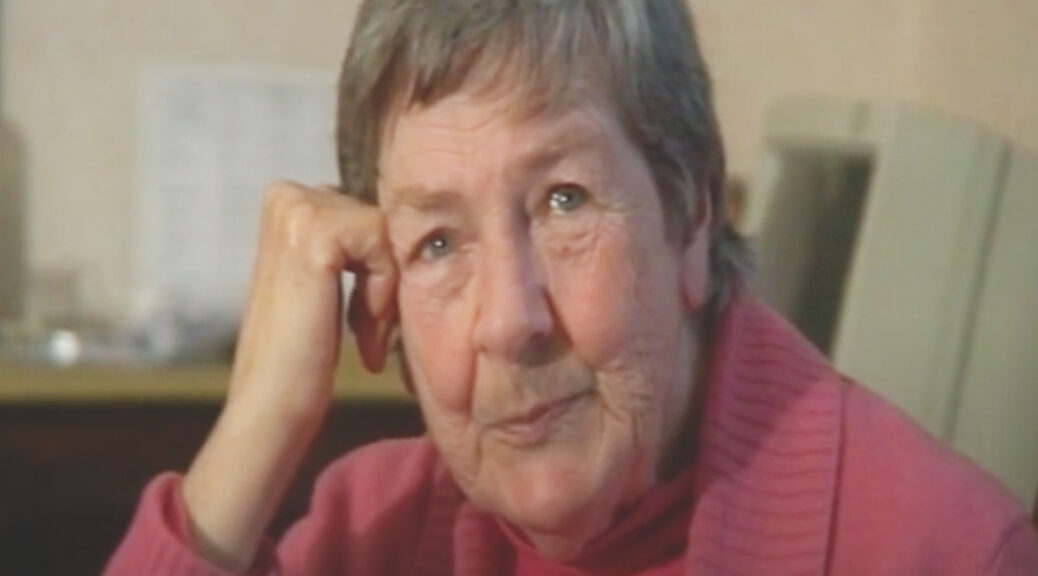
Zelie Jenkinson was born in 1926 and has a long connection with Broad Bay. She shared some of her early memories in a couple of the Broad Bay newsletters in 2008. They have been compiled here. There is also an interview with Zelie, made at the same time, which is available on CD at the Portobello Museum. At time of writing (January 2026) Zelie is about to celebrate her 100th birthday!).
My mother’s parents moved to Broad Bay from Portobello in the early 1940s. I visited and stayed for short holidays. They lived near the top of Hall Road (now Moerangi Street). The Harraways, (the milling people) and Bain families lived opposite them and Miss Sutherland (the Headmistress of Broad Bay School) lived two doors above.
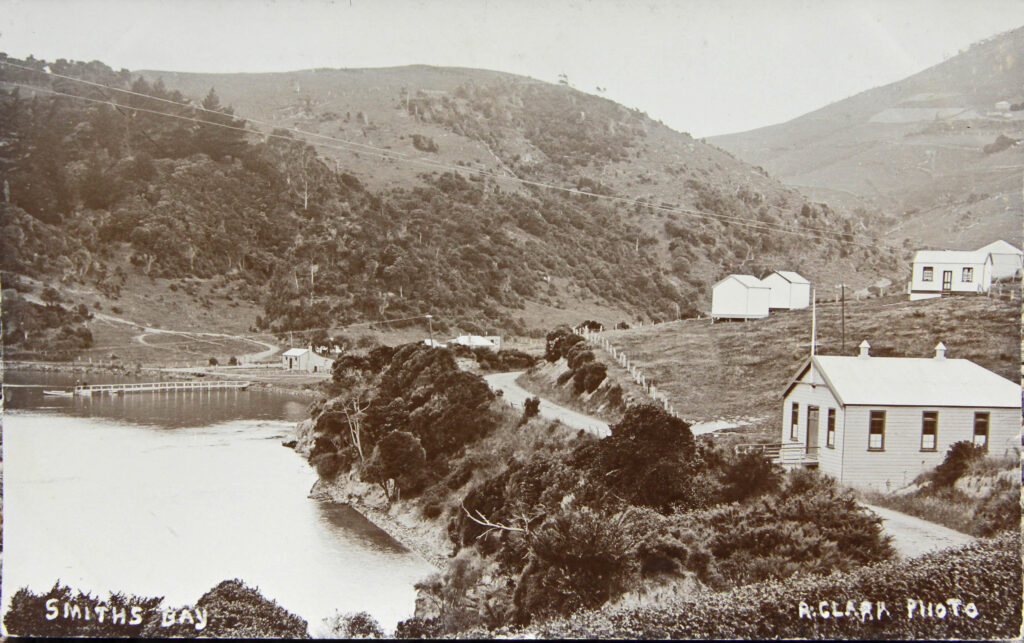
Hall Road (now named Moerangi Street) where it meets Harrington Point Road (now Portobello Road). It was called Hall Road because that is where the community hall was that burned down in February 1954.
Just imagine: no shower, fridge, washing machine, dishwasher, oven, or ice cream. But we had a radio. On holiday at our grandparents’ house was fun. Rainwater was stored in a 200 gallon tank beside the little house in Hall Road. It was called Hall Road because that is where the old Hall was that burned down in the 1950s.
Monday was wash day. The wash-house had a copper and two tubs with a hand-wringer between. The copper fire was lit and when the water was boiling, the soap flakes and whites were put in and a wooden rod was used to keep them moving. They were then lifted into the nearest tub using the wooden rod and rinsed in cold water. Finally they were put through the wringer, unless they needed to stay white, which meant an extra rinse through a blue wash. The washing went into a large basket and was carried outside to the clothesline. The line was strung from one strong post across the lawn to another post. When the line was full, a prop lifted the line up high to catch as much wind as possible. The pegs were wooden and often used to make into dolls for younger children.
The back door led into the kitchen. There was a safe by the back door. It was about the size of an apple crate with a door on one side (inside the house) and mesh on the other side (outside the house) to let the fresh air in, thus keeping whatever was in the safe cool, while keeping flies out. This was where the meat and milk were kept.
The kitchen contained a coal range, bench, sink, cold water tap, table, chairs, cupboards. The kitchen table had a drawer underneath one end, which stored all the cutlery.
Thursday was baking day. Everything was very clean and sparkling. Gran wore her apron. The coal fire was kindled to create a hot oven, as scones were first. The oven door was opened and Gran put her hand in to see if the temperature was high enough. When the scones were done, in went the longer-cooking cakes or currant loaves or biscuits. We loved peanut brownies and helped getting the nuts ready. My Gran was a Scottish woman and we loved her oatcake, which we ate with butter and golden syrup.
There were also two bedrooms and a large living room, where the family would play cards (patience, crib), ludo, snakes and ladders, read, knit and sew, and listen to the radio.
Gran knitted gloves, socks and jerseys for her grandchildren. She taught me to knit. She had long hair which she wore in a bun. When we played ‘hunt the thimble’ (a good indoor game on a wet day) we often hid the thimble in her hair.
On bath night a large tin tub was brought into the living room and filled with hot water from a kettle from the kitchen. Most folk would be off to bed by 10 o’clock.
We children wore old gymshoes when swimming down at Brown’s Beach because of the amount of glass in the harbour. Brown’s Beach, and Brown’s Boatshed, is down from Dr Manheimer’s house, which is the present Caselberg house.
Eventually my father bought a holiday house in John Street (now Matariki Street), but we loved the space and freedom so much that soon 10 John Street became our only home.
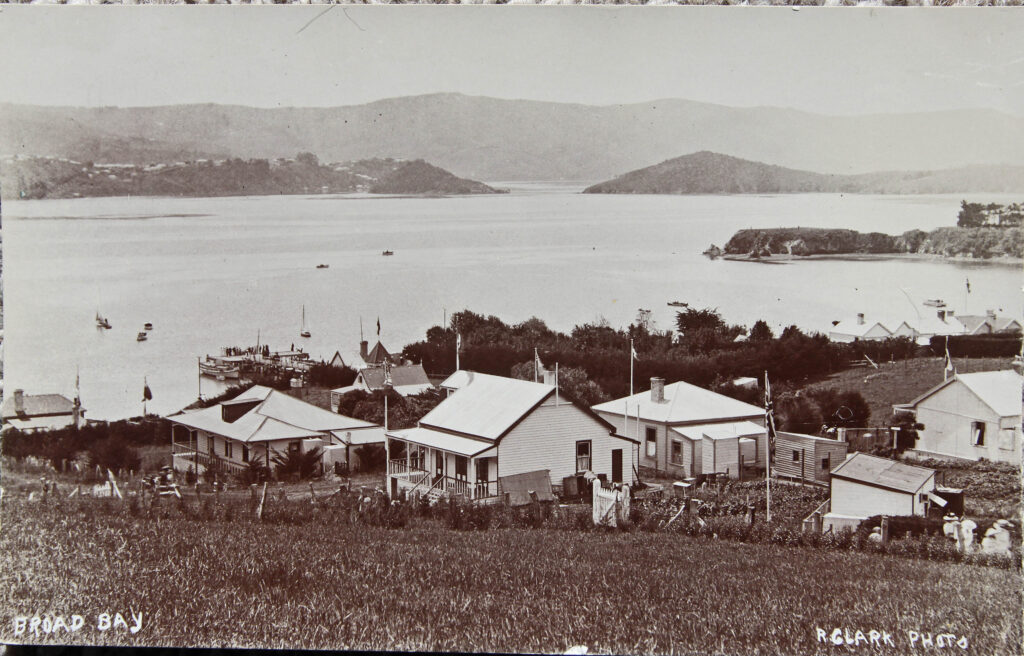
John Street (now Matariki Street) at its junction with Waikana Street.
We came and went by bus. You could count the number of people owning cars on one hand. The roads were loose metal and the buses left deep tracks, which other people followed.
Telephones were few. You used the one at the Post Office if you needed to phone out. The PO was part of the shop at that time, the shop being on the ridge beside Fletcher House. We also went there to collect the mail – there was no delivery.
Mr Black had a farm halfway up Camp Road, and he sledged the milk cans down, and then delivered the milk to your gate by horse and cart. Householders put out their own containers, which he would fill. His three daughters caught the bus to work from the bottom of John Street. They wore galoshes (gumboots) down the hill and changed into the work shoes they kept in a large biscuit tin at McCarthy’s hedge. The older girl and I played tennis on a Sunday afternoon on Speight’s tennis court (which was on the area now containing the Broad Bay Community Hall).
Most families grew their own vegetables, but the Portobello butcher delivered into the Bay. There was also a bread baker there, but eventually the big, two-storey shop in Broad Bay (on the corner of Clearwater Street) had a bakery at the rear, and fresh bread was delivered daily up as far as the Cove. Arnott’s’ Carrying business delivered heavy loads, like cases of fruit and furniture.
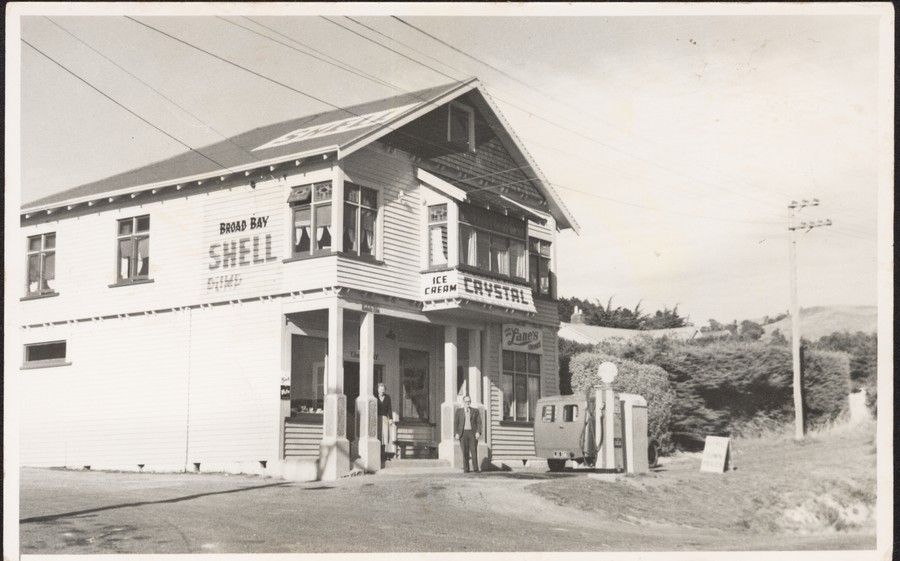
Charles Gray outside his shop on the corner of Clearwater Street and Harrington Point Road (now Portobello Road) in the early 1950s. Note the car at the petrol pump. The track from Chy-an-Dowr to Fantail Lodge is still officially Harrington Point Road!
The 7am bus took most workers to town and was full. The 8am bus was for shoppers, a few school pupils, and folks with business to attend to in the city. Many children left school at Standard 6 level (year 8). The bus drivers lived in the area and looked out for the regulars, even if it resulted in sitting and waiting while the breakfast toast was eaten as the worker rushed down the hill. Some drivers were very well known and respected, including Mr Bayne (owner of the original bus company), Mr Hogg, Murray Parsons and Terry Hart.
The Woman’s Institute held regular meetings and put on concerts in the Hall (then down at the bottom of Hall Road). If you’d heard it, you would never forget the ‘Laughing Policeman’ sung by Mrs Webb Snr. There were flower and vegetable shows. In my dad’s garden he grew three varieties of apples, two kinds of pears, quince, peach, apricot and nectarine trees. We kept a few hens for the eggs and baking. Mother bought a bag (sack) of flour at a time. Families visited among their own friends in the community or through school or church. Because we were a family with four young boys, our interests were in the Boating Club.
My father had been born in Lawrence and had never had the opportunity to learn to swim, so he made sure his sons had every encouragement, and the boys sailed the ‘Sunbeam’ (an Idle-along), the ‘Pixie’ and the ‘Billy Boy’ (P2). At home Mum and I baked for fundraising efforts, mended sails or put in battens etc. Often at weekends we were away with our friends on the launch ‘Omatere’. The boys would row out to the sandbanks and spear flounder for our tea. The boys also knew any deserted apple, plum and pear trees nearby. An old cowbell at our home in John Street was rung to warn sailing brothers a meal was ready.
Dad biked. He shot rabbits and gathered fresh mushrooms. People were not living on nearby properties as the War was still going on. Dad was in the Home Guard and turned out for weekend exercises.